
How Is Technology Changing Event Planning?
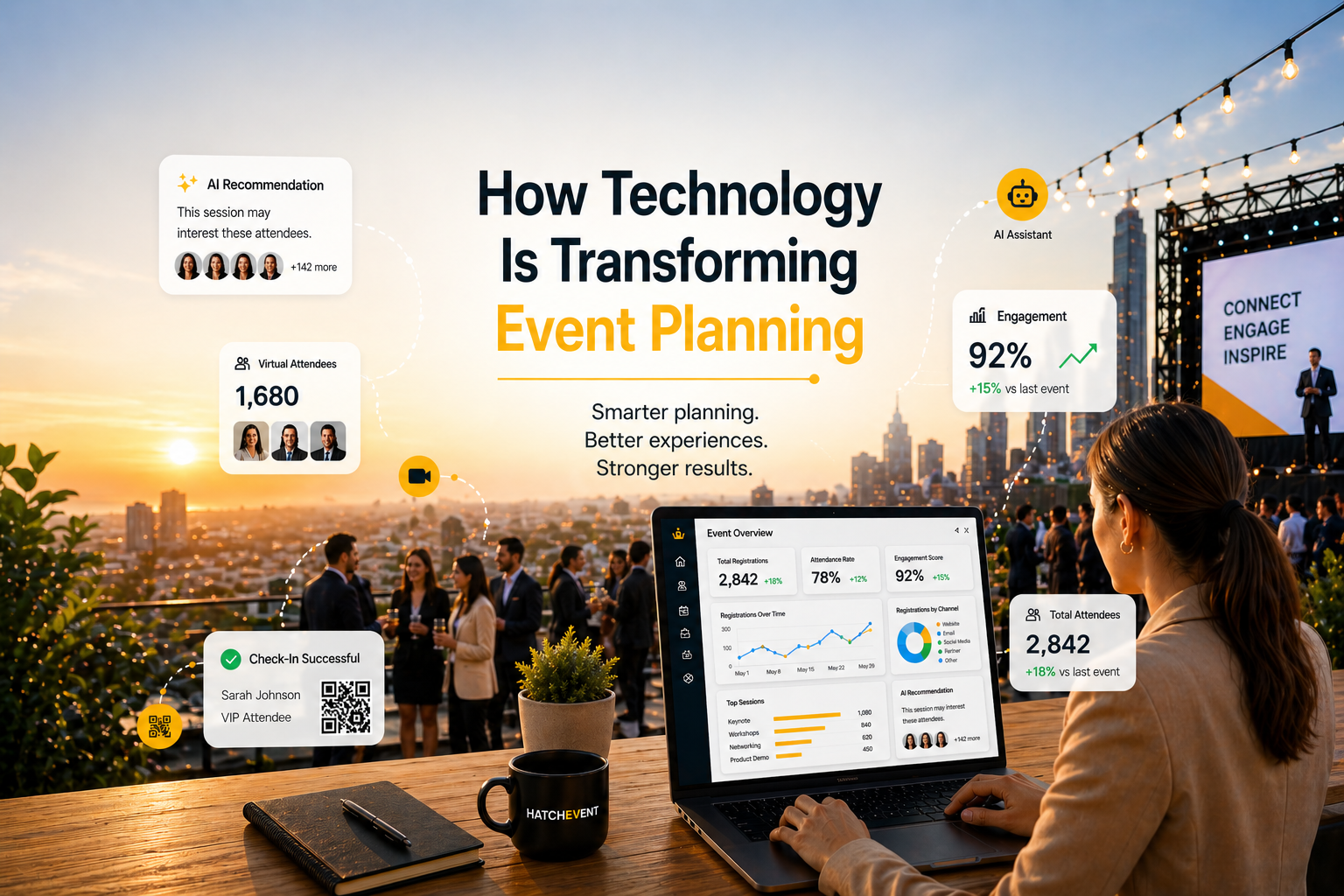
Technology is fundamentally transforming event planning by automating repetitive logistics, enabling global participation through virtual and hybrid formats, personalizing attendee experiences with AI, and giving organizers real-time data that was previously unavailable. What once required weeks of manual coordination from venue sourcing to attendee check-in can now be handled in hours with the right event technology stack.
The global event management software market was valued at $7.8 billion in 2023 and is projected to reach $18.4 billion by 2030, growing at a CAGR of 13.0% (Grand View Research, 2024). This growth reflects how deeply technology has embedded itself in every stage of the event lifecycle.
The 8 Biggest Ways Technology Is Transforming Event Planning
1. Artificial Intelligence Is Automating the Tedious Work
AI is now embedded across the event planning workflow from initial ideation to post-event analysis.
How AI is being used in event planning today:
- Venue sourcing: AI tools can scan thousands of venues and return ranked recommendations based on location, capacity, AV features, and budget in minutes.
- Content generation: Event marketers use AI to draft invitations, promotional emails, social content, and speaker briefs at scale.
- Chatbots for attendee support: AI-powered chatbots handle common attendee questions 24/7, reducing organizer workload by up to 40% (Eventex, 2024).
- Personalized agendas: AI analyzes attendee registration data and past event behavior to recommend sessions most relevant to each individual.
- Post-event analysis: NLP tools analyze open-ended survey responses and social media mentions to surface themes and sentiment far faster than manual review.
“AI doesn’t replace event planners it eliminates the work that prevents planners from doing their best work. Julius Solaris, Founder, Boldpush”
2. Hybrid and Virtual Events Have Permanently Expanded Reach
The COVID-19 pandemic forced the event industry to go virtual almost overnight. What followed was the discovery that digital formats don’t just substitute for in-person events they create new possibilities.
| Format | Pre-2020 Share | 2024 Share |
|---|---|---|
| In-person only | ~85% | ~45% |
| Hybrid (in-person + virtual) | ~5% | ~35% |
| Fully virtual | ~10% | ~20% |
Source: Cvent State of Events Report, 2024
Hybrid events now allow companies to maintain the energy and networking of in-person gatherings while dramatically extending reach. A corporate conference that once drew 500 local attendees can now reach 10,000 global participants simultaneously.
Technologies enabling hybrid events:
- Multi-camera streaming setups with director-level switching
- Interactive audience participation tools (live polling, Q&A, virtual networking rooms)
- On-demand content libraries for attendees who can’t join live
- Synchronized in-room and virtual attendee experiences
3. Event Management Platforms Have Replaced Spreadsheet Chaos
Modern event management software consolidates registration, ticketing, attendee communications, agenda management, and reporting into a single platform eliminating the patchwork of spreadsheets, email chains, and shared documents that defined earlier event planning.
These platforms reduce average event setup time by 60–70% compared to manual processes (Bizzabo Benchmark Report, 2024).
| Platform | Best For | Key Strengths |
|---|---|---|
| Cvent | Enterprise events | End-to-end suite, RFP sourcing |
| Hopin | Hybrid & virtual | Virtual networking, engagement tools |
| Eventbrite | Public & consumer events | Ease of use, ticketing |
| Splash | Brand experience events | Design-forward, marketing integrations |
| Whova | Conferences & trade shows | Mobile app, networking features |
| Bizzabo | B2B events & conferences | Data analytics, CRM integrations |
4. Data Analytics Is Turning Events Into Strategic Assets
One of the most significant technology-driven shifts in corporate event planning is the rise of real-time event data. Organizers now have access to metrics that were unimaginable a decade ago.
Data now available to event planners:
- Registration analytics: Source tracking, conversion rates by channel, drop-off points in the registration flow
- Engagement data: Session attendance rates, dwell time at exhibition booths, app engagement, content downloads
- Sentiment analysis: Live polling results, Q&A participation, post-event NPS scores
- ROI attribution: Lead generation from events, pipeline influence, sponsor ROI tracking
According to Forrester Research (2024), companies that use event analytics to inform future planning see a 31% improvement in attendee satisfaction and a 22% increase in sponsor renewal rates year over year.
5. Contactless and Mobile-First Check-In Has Replaced Paper Registration
The era of printed attendee lists and paper badges is largely over. Today, event check-in is a technology-first experience.
Modern check-in technologies:
- QR code check-in: Attendees scan a code from their phone; badges print automatically in under 5 seconds
- Facial recognition check-in: Used at large-scale conferences; attendees are verified against their registration photo with no physical interaction required
- NFC-enabled badges: Smart badges that track session attendance, enable lead scanning for exhibitors, and trigger personalized push notifications
- Self-service kiosks: Reduce registration staff requirements by 50–70% at large events
The result: average check-in time at large conferences has dropped from 8–12 minutes (paper-based) to under 45 seconds with modern check-in technology (PCMA, 2023).
6. Event Apps Have Transformed the Attendee Experience
Dedicated event apps have replaced bulky printed programs and disconnected experiences with a personalized, interactive hub attendees carry in their pocket.
What event apps offer attendees:
- Personalized agenda builder and session reminders
- Interactive maps and wayfinding for large venues
- Real-time session Q&A and live polling
- Attendee networking and meeting scheduling (AI-matched connections)
- Push notifications for schedule changes and announcements
- Gamification elements (leaderboards, scavenger hunts, session badges)
Impact on engagement: Events using dedicated apps report 40–60% higher session participation and a 3x increase in attendee-to-attendee connections compared to events without apps (Whova, 2024).
7. Sustainability Tech Is Helping Events Go Green
Corporate sustainability mandates are accelerating the adoption of event technology that reduces environmental impact.
- Digital-only collateral: QR-code menus, digital programs, and e-badges eliminate printing costs and paper waste
- Carbon footprint calculators: Platforms like Isla and Pledge calculate per-attendee carbon impact and suggest offsets
- Hybrid attendance as sustainability strategy: Replacing 30% of in-person attendance with virtual attendance reduces an event’s carbon footprint by up to 60% (MeetGreen)
- Smart catering systems: AI-powered catering platforms predict consumption more accurately, reducing food waste by 20–35% (Winnow Solutions, 2024)
- Venue matching tools: Platforms now filter venue searches by sustainability certifications (LEED, ISO 20121, Green Key)
8. Immersive Technologies Are Redefining Event Experiences
At the leading edge of event tech, AR, VR, and generative AI are creating attendee experiences that weren’t physically possible before.
- AR venue tours: Planners use AR to visualize room layouts, lighting setups, and signage placement before an event is built
- VR networking: Attendees use VR headsets to walk through virtual exhibition halls, visit booths, and have face-to-face conversations with remote attendees
- Holographic speakers: Keynote speakers appear as life-size holograms, enabling ‘live’ presentations from speakers who are physically in a different country
- Generative AI for creative production: Event designers use AI to prototype themes, stage designs, and experiential activations in hours rather than weeks
Early adopters report 35–45% higher attendee ‘wow factor’ scores and significantly increased social sharing of event content (Freeman, 2024).
How to Build a Technology Stack for Corporate Events
Small Internal Events (Under 50 Attendees)
| Need | Recommended Tool |
|---|---|
| Registration | Google Forms, Typeform |
| Communication | Mailchimp, Outlook |
| Agenda sharing | Notion, Google Slides |
| Post-event survey | Google Forms, SurveyMonkey |
Mid-Size Corporate Events (50–500 Attendees)
| Need | Recommended Tool |
|---|---|
| Registration & ticketing | Eventbrite, Splash |
| Check-in | Eventbrite app, Cvent OnArrival |
| Event app | Whova, Guidebook |
| Post-event analytics | Bizzabo, native platform reports |
Large-Scale Conferences (500+ Attendees)
| Need | Recommended Tool |
|---|---|
| Full event management | Cvent, Bizzabo |
| Hybrid streaming | Hopin, ON24, StreamYard |
| Check-in & badge printing | Cvent OnArrival, Boomset |
| AI networking & matchmaking | Brella, Grip |
| Sustainability tracking | Isla, Pledge |
| Sponsor ROI tracking | Cvent, Bizzabo |
Challenges and Considerations
Integration complexity.
Many event tech tools don’t natively communicate with CRM systems (Salesforce, HubSpot), marketing automation platforms, or internal project management tools. Budget time and resources for integration work.
Attendee digital fatigue.
Asking attendees to download a new app, join a virtual platform, and complete a pre-event survey can feel overwhelming. Simplify where possible one well-chosen platform beats four mediocre ones.
Data privacy and compliance.
Events collect significant personal data. Ensure your event tech vendors comply with GDPR, CCPA, and applicable regional data regulations. Review DPA (Data Processing Agreements) before signing vendor contracts.
Cost vs. ROI clarity.
Enterprise event platforms can cost $10,000–$100,000+ annually. Build a clear ROI case reduced staff hours, higher attendance conversion, sponsor retention before committing.
Frequently Asked Questions
What is event technology?
Event technology refers to the digital tools, platforms, software, and hardware used to plan, manage, execute, and analyze events. This includes event management software, virtual event platforms, check-in systems, event apps, AI tools, and immersive technologies like AR and VR.
How is AI used in event planning?
AI is used in event planning for venue sourcing and recommendations, personalized attendee agenda curation, chatbot-powered attendee support, automated email and content generation, real-time sentiment analysis, and post-event reporting. Most major event platforms now include AI features natively.
What is a hybrid event?
A hybrid event combines an in-person gathering with a synchronized virtual attendance component, allowing remote participants to engage with speakers, sessions, networking, and content in real time.
How much does event technology cost?
Event technology costs vary by scale. Basic tools (Eventbrite, Google Forms) are free or low-cost. Mid-market platforms cost $1,000–$10,000 per event or $5,000–$30,000 annually. Enterprise platforms (Cvent, Bizzabo) range from $30,000–$150,000+ per year depending on usage and feature set.
Is event technology only for large events?
No. Event technology scales from free tools for 20-person team meetings to enterprise platforms for 50,000-person global conferences. Small teams benefit most from simple, integrated tools that reduce manual communication and automate registration.
What event technology trends are emerging in 2025 and 2026?
Key trends include AI-powered personalization at scale, deeper hybrid event integration, sustainability tracking tools, NFC and facial recognition check-in, generative AI for creative production, and the early-stage adoption of spatial computing for immersive virtual attendance.
Key Takeaway
Technology is not replacing event planners it is elevating what they can accomplish. By automating logistics, enabling global reach, delivering richer data, and creating more memorable attendee experiences, event technology gives planners the capacity to focus on what matters most: designing events that achieve real business outcomes.
The organizations seeing the greatest returns from event tech are those that build deliberately, train their teams thoroughly, and select tools based on clear strategic needs rather than feature lists. Start with your biggest friction points, solve those first, and layer complexity over time.